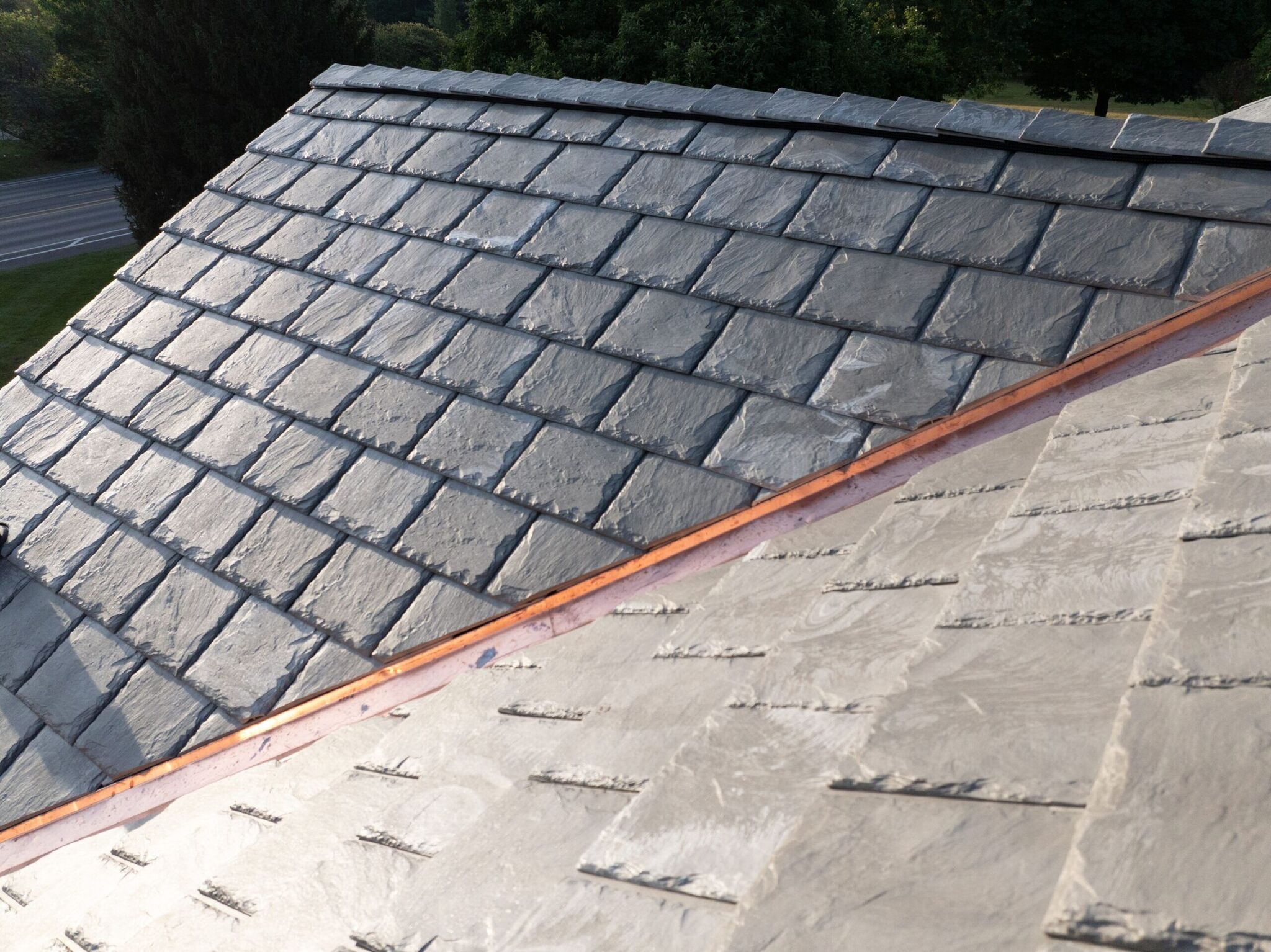
On a prominent Carmel roof or Zionsville roof, the repair has to stop the water and make visual sense. The expensive mistake is paying for a patch that cannot address a failing field or roof system.
Here is how we actually walk a homeowner through it.
First, figure out which kind of problem you have
Most roof trouble is one of three things, and the category — not the price — should drive the decision.
A detail failure — usually repairable. Chimney flashing, a pipe boot, a skylight curb, step flashing where the roof meets a wall, a small wind-lifted area. These are real problems, but they are local. The fix holds when the contractor rebuilds the detail instead of smearing sealant over it. Sealant is a countdown, not a repair.
A field failure — usually points to replacement. Widespread granule loss, brittle shingles, repeated blow-offs, multiple exposed nail lines, soft or wavy deck areas. When the field of the roof is going, patching one section just moves the next failure a few feet over.
A system failure — a repair will not fix the root cause. Chronic ice-dam symptoms, recurring attic moisture, moldy decking, a history of roofs on this house that didn't last. The roof is the symptom; the system underneath is the disease. Re-shingling without correcting it buys you the same failure on a new schedule.
That third category is where we see homeowners lose the most money — paying for repairs that were never going to work because the problem was never the shingles.
The repair that should have been a replacement
A roof we completed in East Hinsdale is a clean system example. The replacement paired Brava Multi-Width Slate on the main roof with a base-and-cap modified-bitumen assembly where the pitch was too low for tile. The water-management scope called for ice-and-water membrane at eaves, roof-wall unions, penetrations, valleys, and low-slope transitions; copper W-valleys; copper counterflashing and chimney flashing; and new copper drainage. None of that is captured by a line item that only says “replace roof.” That is the difference between choosing a surface and designing the transitions that make it work.
One of our clients, Alison D., put the same idea in her own words about a different project — that what stood out was the “thorough inspection both externally and from within the attic, taking pictures so that we could fully understand everything that needed to be fixed.” Ventilation and diagnosis are the unglamorous parts. They are also what decides whether a repair lasts or just resets the clock.
The aesthetic test most contractors skip
In these neighborhoods, a repair is also a visual decision. A patched section that reads as "patched" is something you will see from the curb forever. Before you approve a repair, ask one honest question: will this look like craftsmanship, or like a compromise? Sometimes a roof is sound enough to repair and still worth replacing, because patchwork on a prominent elevation costs you more in how the house reads than a full roof would. A roof can be perfectly legal, perfectly code-compliant, and still be the wrong answer for the house.
A repair-or-replacement table you can use this week
Do not total unlike factors into one score. Read each row in the direction it points, then ask which side has the stronger evidence.
| Decision factor | Evidence for repair | Evidence for replacement |
|---|---|---|
| Remaining roof life | The field is still flexible, intact, and expected to outlast the repair. | The field is brittle, losing granules, lifting, or nearing the end of its useful life. |
| Failure pattern | One traceable detail failed: a boot, curb, flashing joint, or small wind-damaged area. | Failures appear across several planes, details, or repeated repair locations. |
| System health | Decking, ventilation, flashing, and underlayment are sound around the repair. | Moisture, decking, ventilation, or flashing problems extend beyond the visible leak. |
| Appearance | The repair can blend acceptably on a secondary or low-visibility plane. | The patch will stay obvious on a prominent elevation or matching material is unavailable. |
| Ownership timeline | A durable repair matches the years you expect to keep the home. | You plan to stay long enough that repeated repairs would cost more and prolong uncertainty. |
If the evidence is mixed, diagnose the water pathway before choosing. A low repair price does not make a failing field healthy, and an old roof does not make an isolated detail unrepairable.
What it costs to find out
A diagnosis is not a replacement. The project price guide lists repair and leak work at a typical project price of $3,000, with a typical range of $2,000 to $5,000. That is planning context, not a minimum or fixed diagnostic price. The goal of the first visit is to find out whether the water pathway is the problem or merely where the stain appeared.
If replacement is the call, make material a separate decision
Diagnosis answers whether the existing roof can be repaired. It does not automatically choose the next material. Use the Material Fit Advisor to compare the home’s look, hold time, budget, site conditions, and maintenance tolerance, then check current category ranges in the Cost & Scope Index.
What to ask any contractor before you decide
- What specifically failed — the material, a detail, or the system?
- If we repair, how likely is this to come back within 12 to 24 months, and why?
- Can you show me photos of the failure points, instead of only a measurement?
- What is the water pathway here, and does your plan address it or just the stain?
- If we replace, what changes about ventilation and flashing versus what's up there now?
If the answers are vague, you are being sold a guess. The calm way to decide is to make the diagnosis specific first — then the repair-or-replace question usually answers itself.